Spectroscopy Explained
Decode starlight to reveal the chemical composition, temperature, and motion of celestial objects.
What is Spectroscopy?
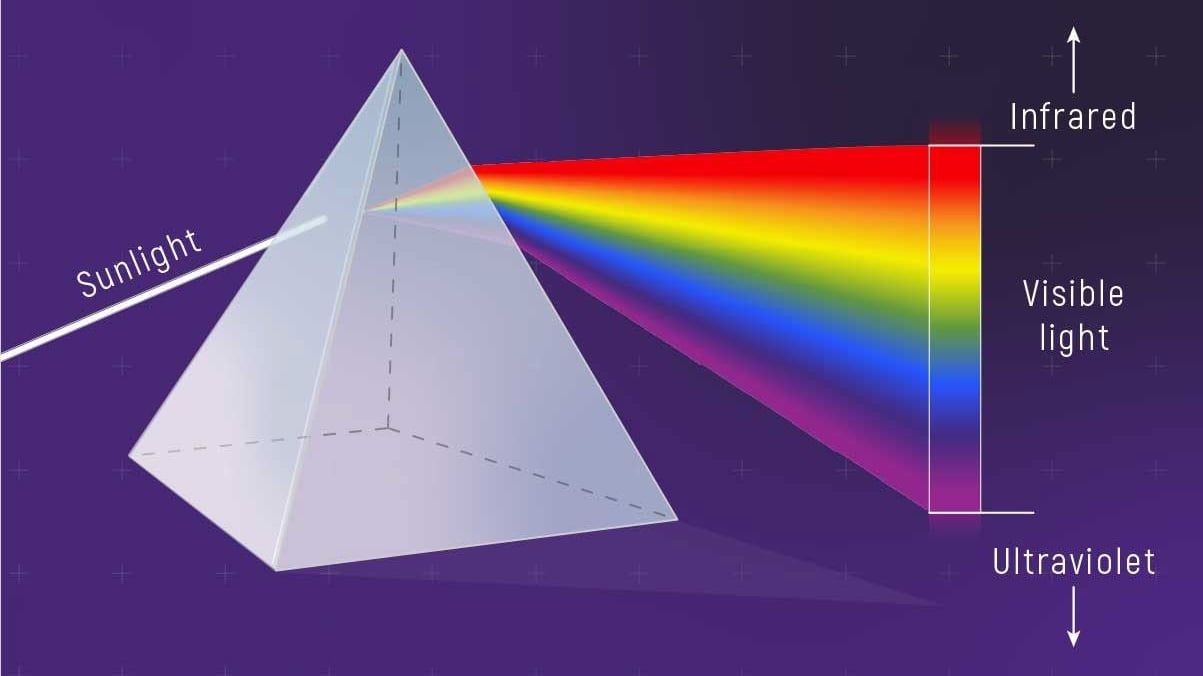
Spectroscopy is the study of how light interacts with matter. By spreading light into its component wavelengths — creating a spectrum — astronomers can decode the composition, temperature, density, and motion of distant objects.
Just as each person has unique fingerprints, every element and molecule absorbs and emits light at specific wavelengths, leaving telltale spectral lines.
Two Types of Spectral Lines
Elemental Spectral Fingerprints
Visible Spectrum with Absorption Lines
Hydrogen
(Balmer series)Most abundant element; key indicator of stellar temperature
Sodium
(Sodium doublet)Found in stellar atmospheres and exoplanet hazes
Calcium
(H and K lines)Strong indicators of stellar age and metallicity
Iron
(Multiple lines)Traces stellar evolution and supernova enrichment
From Photons to Facts
Here's how scientists transform raw starlight into groundbreaking discoveries:
Collect Photons
Telescope gathers light from a distant object
Split Into Spectrum
Diffraction grating separates light by wavelength
Identify Lines
Dark absorption or bright emission lines appear
Match Elements
Each element has a unique spectral fingerprint
Determine Properties
Composition, temperature, density, and motion
Measure Redshift
Shifted lines reveal speed and cosmic distance
Redshift & Cosmic Distance
When an object moves away from us, its light is stretched to longer (redder) wavelengths — this is redshift. The faster it recedes, the greater the shift.
Cosmological redshift, caused by the expansion of space itself, is the key tool for measuring the distances to the most remote galaxies.
Redshift Formula
z > 0 means the object is moving away (redshift); z < 0 means approaching (blueshift).
Visualizing Redshift